# #
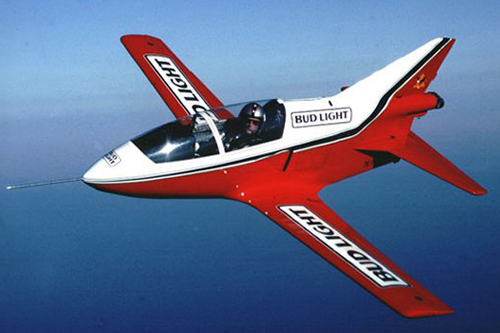
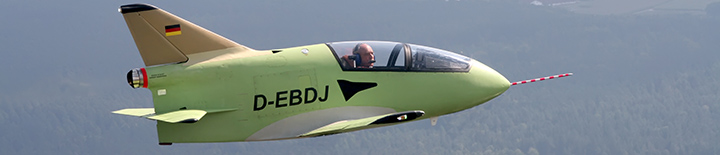
Between May 15 and August 1, 2012, 3 new BD-5J made their first flight !!!United...
In Japan, the first experiment on Jet Engine was begun in 1941 by a navy officer Tokutasu Tanegashima. Tanegashima visited France, Switzerland and USA in 1940. He had been motivated by the information on the European movement, and when Admiral Matsukasa had accepted Tanegashima's proposal in spite of having no response from the Ministry (Military top).
The experiments proceeded include Campini type fan jet : The TSU-11.
The TSU-11 concisted of a piston engine (in this case a 130 hp air-cooled Hatsukaze HA-11, four cylinder, in-line type) driving a geared-up ducted fan as a compressor, following which extra fuel was burned in an exhaust duct. Vanes straightened out of the airflow from the compressor before the extra fuel was injected.
The TSU-11 is said to have had a static thurst of 200 kp (441 lb) at 3000 rpm (the fan itself rotating at 9000 rpm), for a weight of about 200 kg.
TSU-11, CHIBA plant
First japanese turobojet series were designated TR (Turbin Rocket). Early in 1945 TR designations were changed to NE (Nensho for combustion rocket).
The first turnojet, The TR-10 was built by Era. It was developed around a centrifugal compressor (adapted from a turbocharger) and a single-stage turbine. A bench test of the TR-10 was made in 1943 but the compressor gave a pressure ratio of only 3.5:1 (4.1 was expected) and overall efficiency of the engine was only about 50%.
Finally a new design incorporated a four-stage axial compressor and a new inlet duct in front of the centrifugal compressor, with a view to easing the load on it. The turbojet was designated TR-12. When completed at 350 Kg (772 lb), it was found to be heavier than the thrust it produced. it was then refined to lighten it and was designated the TR-12b.
Layout of the TR-12b turbojet engine with a four-stage axial compressor, a centrifugal compressor and reversed-flow combustion chamber
The TR-12b fuel consumption was 510 kg (1,125 lb) per hour. It was planned to flight test the TR-12b beneath a Mitsubishi G4M2 Betty bomber in November 1944, but it is not known if this was done.
All work on the TR-series of engines was abandonned realy in 1945 when the first information of developmeents in Germany was received.
In July 1944, the Japanese military attache stationed in Germany returned home with a few photocopies, including a cross-section of the BMW 109-003 turbojet and some general materials concerning the Me-262 fighter and Me-163 interceptor.
The important data such as the schematic drawings, however, were being transported by a submarine which was sunk.
When details, breaf as they were, of the BMW 19-003 reached Japan, the Army and Navy held a joint conference (a rare event) at which it was decided that a Japanese version of this turbojet held more promise in the short term than Japanese work still in its early stage. this resulted in 4 projects.
The Ne-20 was the navy Project headed by Osamu Nagano assisted by Tanegashima at Kugisho in Yokosuka. The Ne-20 was to became the Japan's most successul turbojet and the other 3 projects were not fully developped in the time available.
It was the Tokyo Ishikawajima Shipyards that was chosen by the navy to be in charge of trial-manufacture and mass production of jet engines (for commercial use also).
Koichi Ichida, chief of the Business Planning Department, National Aerospace Development Agency, says that Reciprocal engines were the main power during the war, but Ishikawajima made steam turbine engines for ships.
It is close to a jet engine because of the rotating mechanism, which is different from a piston engine. That is why turbo engines were researched for automobile engines too.
Indeed, Nakashima Aeroplane and Mitsubishi Heavy Industries also were directed to do trial-manufacture with the same one-page diagram from Germany, but both were unable to realize it.
NE-20 [Source : Tanabe ]
Three Ne-20s have been preserved to the present day :
Everything concerning aircraft, including the Ne-20, was either destroyed by the Allied Powers or brought back to the United States.
Then, for a seven-year period Japan was prohibited from anything related to aviation. Not only research and development, but the path to civil aviation also was c1osed.